If your doctor has told you that a liver transplant may be needed, your head is probably full of questions. What does the process actually look like? How long does it take? What happens in the surgery? What comes after?
This guide answers all of that. It covers the full liver transplant process in Ahmedabad, India – from your very first evaluation to going home and living well after surgery.
What Is a Liver Transplant?
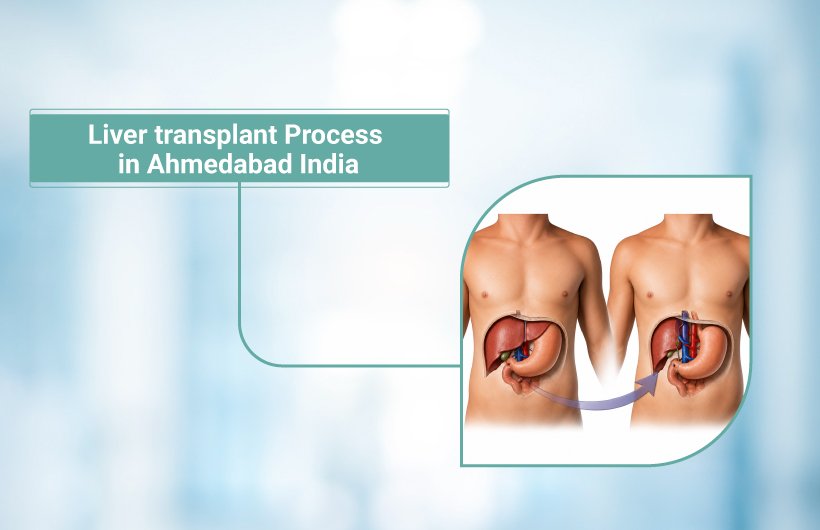
A liver transplant is a surgery where your damaged liver is removed and replaced with a healthy one from a donor. It’s recommended when the liver is so severely damaged that it can no longer do its job – and no other treatment can reverse that damage.
The liver performs over 500 functions in your body – from filtering toxins and producing bile to regulating blood sugar and supporting immunity. When it fails, the consequences are life-threatening. A transplant gives the liver – and the patient – a second chance.
Who Needs a Liver Transplant?
Not every liver condition leads to a transplant. But for certain severe or end-stage conditions, it becomes the only option. Common reasons a transplant is recommended include:
- Liver cirrhosis – where healthy liver tissue is replaced by scar tissue over time
- Liver cancer (hepatocellular carcinoma) – in selected cases where the tumour is contained
- Hepatitis B or C -related liver failure – where the virus has caused irreversible damage
- Acute liver failure – a sudden, rapid loss of liver function, sometimes triggered by medications or infections
- Non-alcoholic fatty liver disease (NAFLD) – in advanced cases leading to cirrhosis
- Autoimmune liver diseases – such as autoimmune hepatitis or primary biliary cholangitis
Your liver specialist will assess whether transplantation is the right path for you based on the nature and severity of your condition.
Types of Liver Transplant
There are two main types of liver transplant. The right one for you depends on your medical condition, urgency, and whether a suitable donor is available.
Living Donor Liver Transplant (LDLT)
In a living donor transplant, a healthy person – usually a blood relative – donates a portion of their liver. The liver is remarkable in that it can regenerate. Both the donor’s remaining liver and the transplanted portion grow back to full size within a few weeks.
This type is more common in India because deceased donor organ availability is limited. The donor must be a close family member, share a compatible blood group, and pass a thorough medical and psychological evaluation before surgery is approved.
Deceased Donor Liver Transplant (DDLT)
In a deceased donor transplant, the whole liver comes from someone who has been declared brain-dead and whose family has consented to organ donation. In India, deceased donor organs are allocated through a national registry system – NOTTO (National Organ and Tissue Transplant Organisation) – based on medical urgency.
Waiting times for a deceased donor liver can be unpredictable, which is why living donor transplants are often pursued where possible.
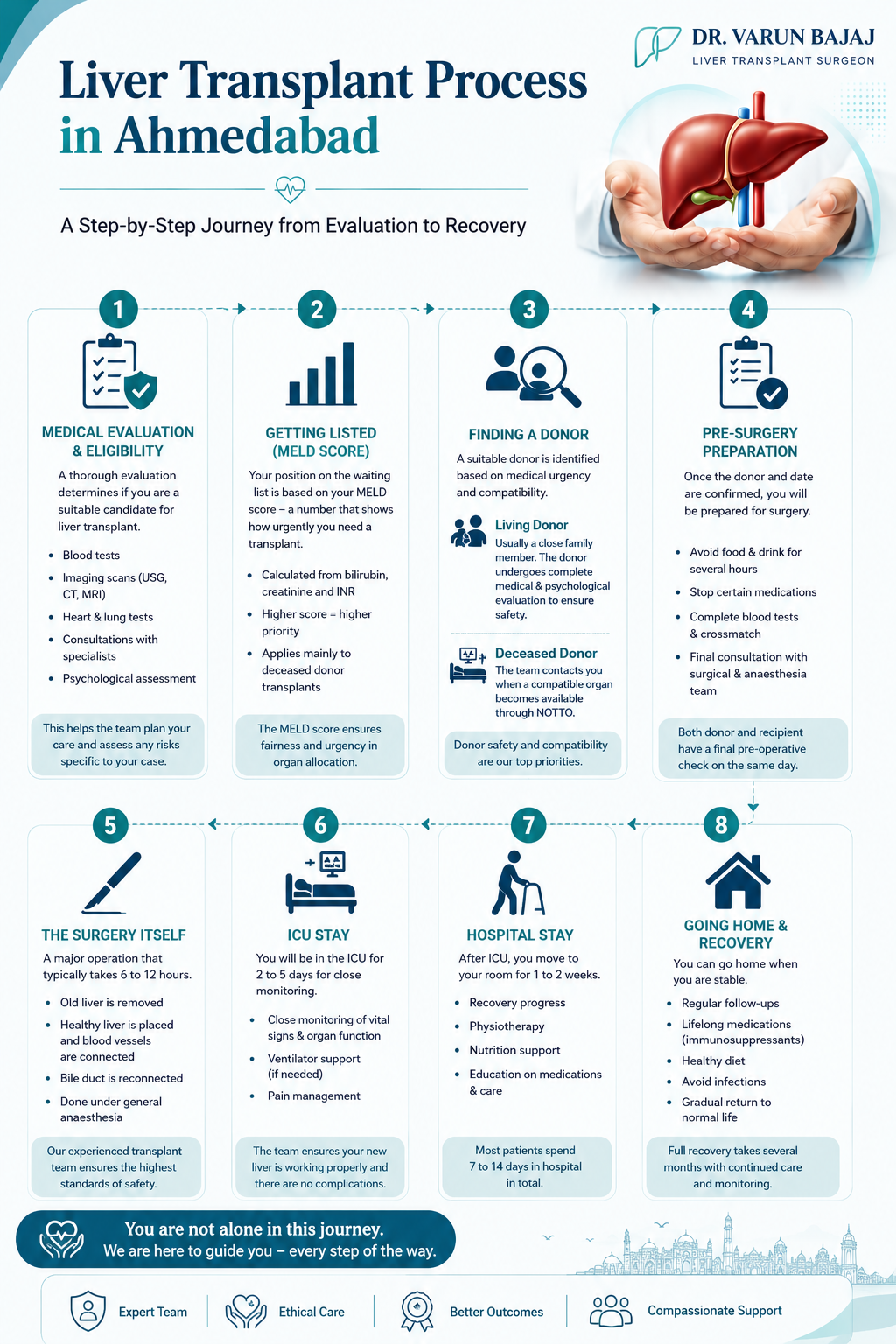
The Liver Transplant Process – Step by Step
Understanding the process helps reduce anxiety. Here is what the journey looks like, from start to finish.
Step 1 – Medical Evaluation and Eligibility
Your transplant journey begins with a thorough evaluation at a transplant centre. This is not a single appointment – it’s a series of tests and consultations carried out over several days or weeks.
The evaluation typically includes:
- Blood tests – liver function, kidney function, blood group, viral markers
- Imaging scans – ultrasound, CT scan, or MRI to assess liver size and blood vessels
- Heart and lung tests – to confirm you’re fit enough for major surgery
- Consultations with a hepatologist, transplant surgeon, anaesthetist, and dietitian
- Psychological assessment – to ensure you’re mentally prepared for the journey
This evaluation determines whether you are a good candidate for transplant. It also helps the team plan the surgery and anticipate any risks specific to your case.
Step 2 – Getting Listed (The MELD Score Explained Simply)
Once you’re approved for a transplant, you’re placed on the waiting list. Your position on that list is determined by your MELD score – which stands for Model for End-Stage Liver Disease.
Think of the MELD score as a number that measures how urgently you need a transplant. It’s calculated from three blood test results: bilirubin, creatinine, and INR (a measure of blood clotting). The higher your MELD score, the sicker you are – and the higher your priority on the waiting list.
This step applies mainly to deceased donor transplants. If a living donor is already identified, the process can move more quickly.
Step 3 – Finding a Donor
For a living donor transplant, the donor is usually a close family member. They go through their own independent evaluation – including blood tests, imaging, and psychological assessment – to confirm they are healthy enough to donate and fully informed about what the surgery involves. Donor safety is treated as seriously as recipient safety.
For a deceased donor transplant, the transplant team will contact you as soon as a compatible organ becomes available. This can happen at any time, so it’s important to stay reachable and be ready to come in quickly when the call comes.
Step 4 – Pre-Surgery Preparation
Once a donor and date are confirmed, the preparation phase begins. You’ll be asked to:
- Avoid eating or drinking for several hours before surgery
- Stop certain medications as advised by your surgeon
- Complete any outstanding blood tests or crossmatch tests
- Have a final consultation with the surgical and anaesthesia team
The donor also undergoes a final pre-operative check on the same day.
Step 5 – The Surgery Itself
A liver transplant is a major operation. It typically takes between 6 to 12 hours, depending on the complexity of your case and the type of transplant.
You’ll be under general anaesthesia throughout – you won’t feel or remember anything. The surgical team will:
- Remove your damaged liver carefully, preserving the surrounding blood vessels
- Place the donor liver in the correct position
- Reconnect the blood vessels and bile duct with great precision
- Close the incision and transfer you to the ICU
Simultaneously, if it’s a living donor transplant, a separate surgical team will be operating on the donor to remove the required portion of their liver.
Step 6 – ICU and Hospital Recovery
After surgery, you’ll wake up in the ICU (Intensive Care Unit). This is where close monitoring happens – your new liver is watched carefully for signs that your body is accepting it.
ICU stay is typically 5 to 7 days. After that, you’re moved to a regular ward for continued recovery. Most patients stay in the hospital for a total of 2 to 3 weeks after the transplant, though this can vary based on how quickly you recover and whether any complications arise.
During this time, you’ll start immunosuppressant medications – drugs that prevent your immune system from rejecting the new liver. These medications are lifelong, though the doses usually reduce over time.
Step 7 – Going Home and Long-Term Care
Discharge doesn’t mean the journey is over. After leaving the hospital, you’ll need to:
- Stay in Ahmedabad for follow-up visits for at least 4 to 6 weeks after discharge
- Attend regular blood test appointments to check liver function and medication levels
- Follow a specific diet and avoid alcohol completely
- Take your immunosuppressant medications every single day, without fail
- Watch for warning signs of rejection – fever, yellowing of skin, abdominal pain – and contact your team immediately
Most patients return to normal daily activities within 3 to 6 months. Full recovery, including return to work, typically happens by 6 to 12 months depending on the individual.
How Long Does a Liver Transplant Take?
Here’s a quick summary of the timeline:
| Phase | Typical Duration |
| Pre-transplant evaluation | Several days to a few weeks |
| Surgery | 6 to 12 hours |
| ICU stay | 5 to 7 days |
| Total hospital stay | 2 to 3 weeks |
| Post-discharge follow-up in Ahmedabad | 4 to 6 weeks |
| Return to normal activities | 3 to 6 months |
| Full recovery | 6 to 12 months |
Liver Transplant in Ahmedabad – Why Families Choose It
Ahmedabad has grown into one of India’s reliable destinations for liver transplant surgery. Families choose it for several reasons:
- Experienced transplant teams – Ahmedabad hospitals have performed hundreds of liver transplants, with well-established protocols and multi-disciplinary teams
- Advanced infrastructure – modern ICUs, transplant operation theatres, and post-operative care units
- Significantly more affordable than Western countries – liver transplants in India cost 70–85% less than comparable procedures in the US, UK, or Europe, without compromising on quality
- Local accessibility – for patients from Gujarat and surrounding states, receiving treatment close to home makes the recovery phase easier for families
Cost of Liver Transplant in Ahmedabad
Cost is one of the first things families want to understand – and rightly so. In Ahmedabad, the cost of a liver transplant typically ranges from ₹15 lakhs to ₹35 lakhs. This is not a fixed price – several factors affect the final figure:
- Type of transplant – living donor or deceased donor
- Complexity of your specific case – multiple conditions or prior surgeries can increase cost
- Hospital infrastructure and facilities
- Length of ICU and hospital stay
- Post-surgery medications, particularly immunosuppressants, which are a recurring cost
Pre-operative tests alone can cost between ₹40,000 and ₹70,000, depending on the hospital and the tests your team recommends. It’s worth asking for a detailed cost breakdown upfront so there are no surprises.
Financial Help and Insurance
The cost of a liver transplant can feel overwhelming. But there is support available:
- Ayushman Bharat (PM-JAY) – the government health scheme covers liver transplants for eligible families (up to ₹5 lakhs per year) at empanelled hospitals. Eligibility is based on the Socio-Economic Caste Census (SECC).
- Chief Minister’s Relief Fund / Prime Minister’s Relief Fund – applications can be made for partial or full financial assistance in cases of genuine need
- Crowdfunding platforms – platforms like Ketto and Milaap have helped many Indian families raise funds for liver transplants
- Health insurance – check whether your policy covers organ transplants; many now do, though terms vary widely
Speak to the hospital’s patient counsellor or social worker early in the process. They’re experienced in helping families navigate the financial side of transplant care.
Book a Consultation with a Liver Specialist in Ahmedabad
If you or a loved one has been advised to consider a liver transplant, liver disease treatment, cirrhosis management, fatty liver care, or a second opinion regarding liver surgery, consult Dr. Varun Bajaj for a comprehensive evaluation and personalized treatment plan.
About Dr. Varun Bajaj
Dr Varun Bajaj is a Gastrointestinal Specialist and Liver Specialist in Ahmedabad with expertise in diagnosing and managing liver diseases, including cirrhosis, fatty liver disease, hepatitis, gastrointestinal disorders, and liver transplant evaluation. He is committed to providing evidence-based, patient-centered care and helping patients make informed decisions about their treatment journey.
Talk to Dr. Varun Bajaj
Every liver transplant journey is different. The right plan for you depends on your specific condition, test results, and overall health – and it needs to be built around you, not a generic checklist.
If you or a family member is facing a liver transplant decision in Ahmedabad, schedule a consultation with Dr. Varun Bajaj – Gastrointestinal Specialist and Liver Specialist in Ahmedabad. You’ll get honest, clear answers and a personalised assessment of your next steps.
FAQs
Can a family member donate part of their liver?
Yes. In a living donor liver transplant, a close family member can donate a portion of their liver. The donor must be of compatible blood group, in good health, and willing to undergo an independent medical and psychological evaluation. The liver’s ability to regenerate means both donor and recipient end up with a functioning liver.
What is the success rate of liver transplant in India?
Liver transplant outcomes in India have improved significantly over the past decade. One-year survival rates average around 85–90%, and five-year survival rates are approximately 70–75%, though outcomes vary based on the patient’s underlying condition, age, and overall health at the time of transplant.
How long is recovery after a liver transplant?
Most patients are in the hospital for 2 to 3 weeks after surgery. After discharge, you’ll need to remain in Ahmedabad for follow-up visits for another 4 to 6 weeks. A return to light daily activities typically happens within 3 to 6 months, with full recovery – including return to work – usually by 6 to 12 months.
Is Ahmedabad a good city for liver transplant surgery?
Yes. Ahmedabad has established transplant centres with experienced surgical teams, modern ICUs, and comprehensive post-operative care. It offers a strong combination of clinical quality and relative affordability compared to metros like Mumbai or Delhi, while remaining accessible for patients and families from across Gujarat and western India.
What happens if my body rejects the new liver?
Some degree of immune response to the new liver is common and expected. This is why immunosuppressant medications are given – to keep the immune system from attacking the donor organ. Your transplant team monitors you closely for rejection, especially in the first few months. Most cases of acute rejection can be managed effectively with medication adjustments if caught early.
Medical Disclaimer: This article is for informational purposes only. It does not constitute medical advice. The best approach to liver transplant – including type, timing, and surgical plan – always depends on the individual patient’s condition, the surgeon’s clinical assessment, and the facilities available. Always discuss your specific situation with your surgeon before making any medical decisions.