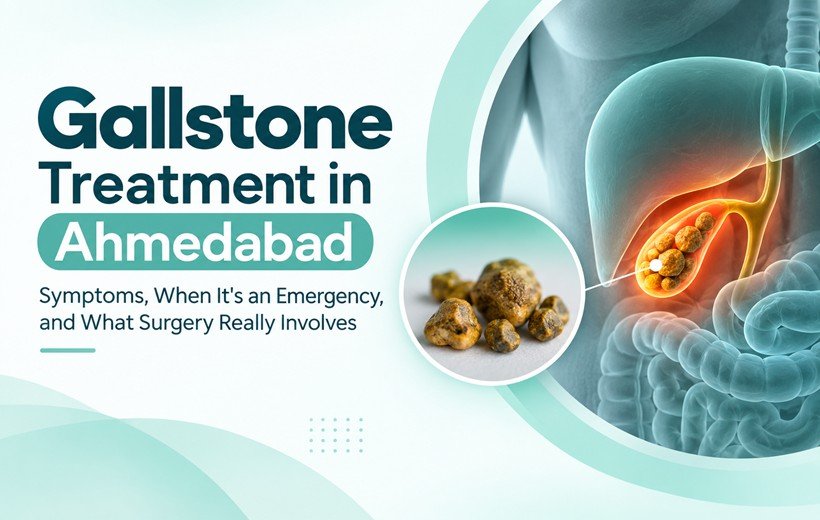
If you’ve been getting a sharp, cramping pain under your right ribs after a heavy or oily meal, gallstones are one of the first things we check for. Most people carry them without knowing, until one attack sends them to the emergency room. Understanding gallstone treatment in Ahmedabad early can mean the difference between a planned, low-risk surgery and an unplanned one at 2 AM. As a gastro surgeon in Ahmedabad, I see this pattern often enough that I want to walk you through exactly what to watch for and what your options are.
What Are Gallstones?
Gallstones are small, hardened deposits that form inside your gallbladder a small pouch under your liver that stores bile, the fluid your body uses to digest fat. When bile has too much cholesterol or bilirubin, or the gallbladder doesn’t empty properly, these substances crystallize into stones. They range from tiny grains of sand to stones over 2 cm wide, and a person can have one large stone or dozens of small ones.
Many patients are surprised to learn they’ve had gallstones for years with no symptoms at all. The stones only become a problem when one blocks the flow of bile.
What Does Gallstone Pain Actually Feel Like?
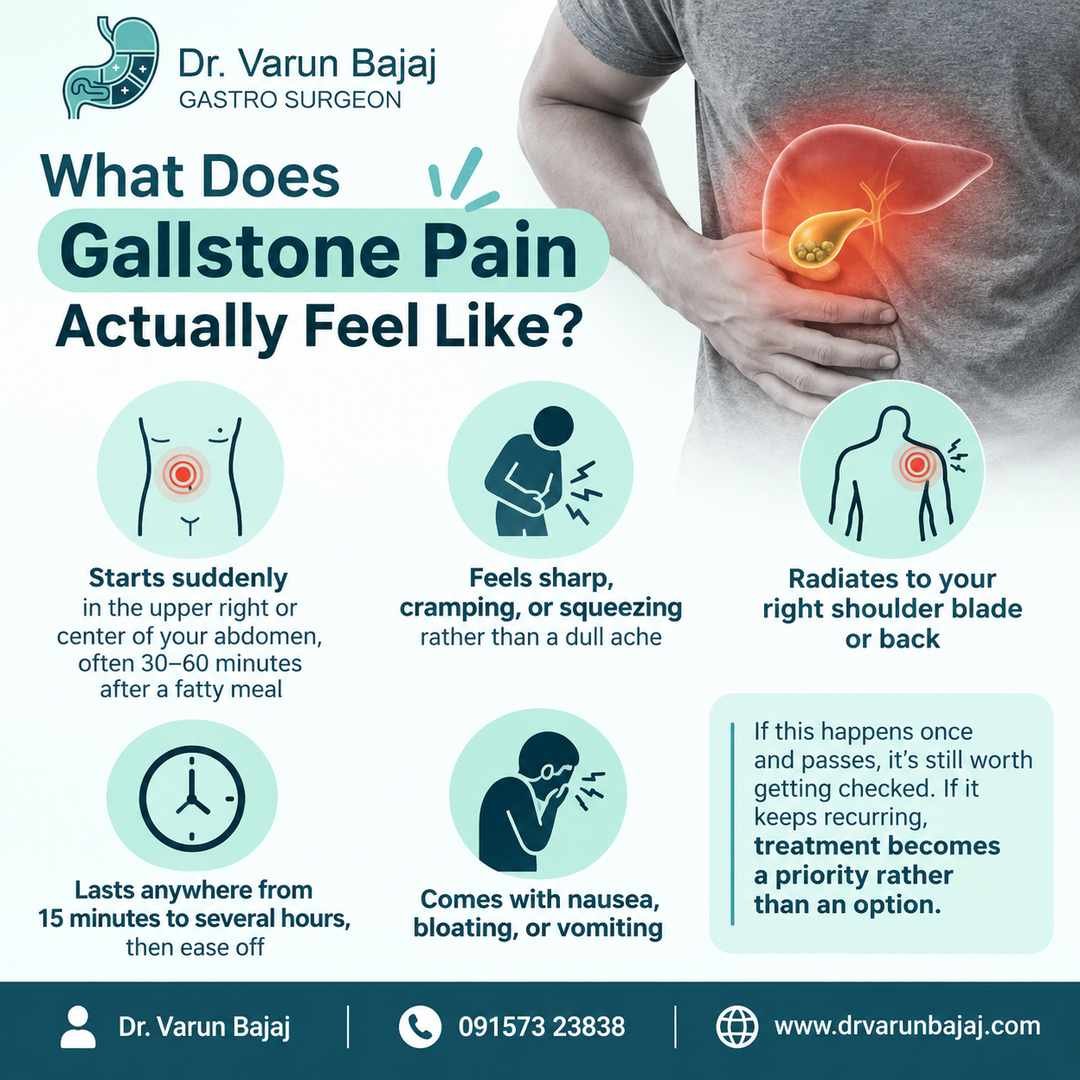
This is the question I get asked most, because the pain is easy to mistake for gas or a bad meal. Gallstone pain (called biliary colic) tends to:
- Start suddenly in the upper right or center of your abdomen, often 30–60 minutes after a fatty meal
- Feel sharp, cramping, or squeezing rather than a dull ache
- Radiate to your right shoulder blade or back
- Last anywhere from 15 minutes to several hours, then ease off
- Come with nausea, bloating, or vomiting
If this happens once and passes, it’s still worth getting checked. This pain pattern is also easy to confuse with other causes of stomach pain after eating food, so if it keeps recurring, treatment becomes a priority rather than an option.
When Gallstones Become a Medical Emergency
This is the part patients genuinely need to know, because waiting too long turns a straightforward surgery into a complicated one. Go to a hospital immediately if you have:
- Pain that doesn’t ease after several hours
- Fever or chills along with abdominal pain
- Yellowing of your skin or eyes (jaundice)
- Dark urine or pale, clay-colored stools
- Persistent vomiting with inability to keep fluids down
These can signal that a stone has blocked your bile duct or triggered an infection of the gallbladder conditions that need urgent attention, not a wait-and-see approach. If you’re unsure whether what you’re feeling fits this pattern, our overview of early signs of gastrointestinal disease can help you tell the difference.
How Is Gallbladder Stone Surgery Done?
If your gallstones are causing repeated symptoms, the standard and most effective treatment is removing the gallbladder itself, not just the stones, since new stones tend to form again in the same organ. I perform this as a laparoscopic cholecystectomy: three or four small incisions, a camera, and fine instruments to remove the gallbladder without a large surgical cut. Most patients go home within 24 hours and are back to light activity within a week. Dr. Varun Bajaj has performed this procedure regularly across a career built on laparoscopic and hepatobiliary surgery, and for the vast majority of patients, it resolves the problem completely with no recurrence.
Open surgery is occasionally needed for complicated cases, for example, severe inflammation or scar tissue from a prior surgery, but this is the exception rather than the rule today.
Can You Live Normally Without a Gallbladder?
Yes. This is the honest answer, and it surprises a lot of patients. Your liver still produces bile after the gallbladder is removed; it just flows more continuously into your intestine instead of being stored and released in bursts. Most people notice no long-term dietary restrictions. In the first few weeks, some patients find that large, high-fat meals cause loose stools or bloating simply because bile isn’t being released in a concentrated dose anymore; this usually settles as your digestive system adjusts. I generally advise smaller, more frequent meals early on and a gradual return to your normal diet.
Conclusion
Gallstone pain is easy to dismiss as “just something I ate,” but recurring attacks are your body telling you something needs attention. Understanding your symptoms, knowing when they cross into emergency territory, and knowing what surgery actually involves takes the fear out of the decision. Most patients who go through this procedure are surprised at how manageable the recovery is, and how quickly life goes back to normal.
Gall Bladder Surgery in Ahmedabad
If you’re noticing the pattern described above, don’t wait for the next attack to be worse than the last. Contact us to book a consultation, or reach out on WhatsApp to ask a quick question first.
Frequently Asked Questions
Q: Are gallstones common in India, or is this rare?
A: They’re common enough that we see cases regularly, and they appear to be increasingly diagnosed in younger adults, not just older patients. Diet, rapid weight loss, and family history all play a role.
Q: Can gallstones be treated without surgery?
A: If a stone is small and you have no symptoms, we may simply monitor it. Once stones cause repeated pain, medication rarely dissolves them effectively, and surgery remains the definitive treatment.
Q: Is laparoscopic gallbladder surgery safe?
A: Yes it’s one of the most commonly performed and well-established procedures in general surgery, with a strong safety record and quick recovery for the large majority of patients.
Q: How soon can I return to work after surgery?
A: Most patients with desk jobs return within a week. Physically demanding work may need two to three weeks, depending on your recovery.
Q: Will I need to avoid fatty food forever?
A: No. Most people can eventually eat normally. The adjustment period is usually weeks, not a lifetime.
Q: What happens if I ignore gallstone symptoms?
A: Repeated attacks can progress to gallbladder infection, a blocked bile duct, or pancreatitis all of which are more serious and harder to treat than the original gallstones.