
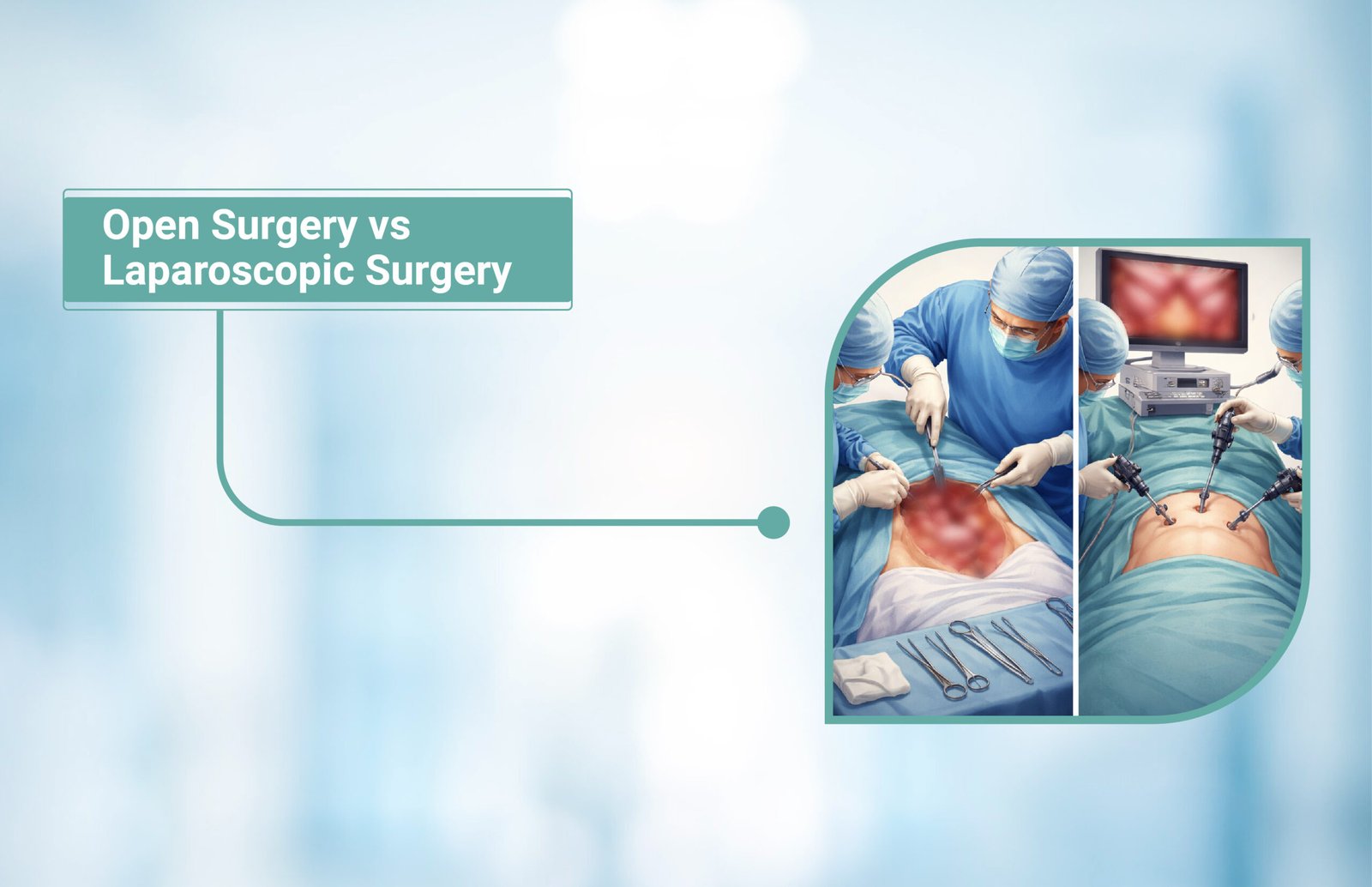
If your surgeon has mentioned two surgical options, open surgery and laparoscopic surgery, you probably want to know what each one involves, how they differ, and what it means for your recovery. This page explains both approaches clearly, so you can have a more informed conversation with your surgical team.
The main difference between open surgery and laparoscopic surgery is the size of the incision and how the surgeon accesses the area being treated. Open surgery uses a single large cut. Laparoscopic surgery, also called keyhole surgery or minimally invasive surgery, uses several very small incisions and a tiny camera to guide the procedure.
Neither approach is universally better. The right choice depends on your specific condition, your overall health, and your surgeon’s judgment.
What is Open Surgery?
Open surgery is the traditional surgical method. The surgeon makes a single large incision, typically 6 to 12 inches long, to directly access the organ or tissue that needs treatment.
This direct access gives the surgeon a full, hands-on view of the surgical site. They can see and feel the area, which can be critical in complex or emergency situations.
Open surgery is typically used when:
- The condition is complex or has spread to nearby structures
- There is internal bleeding or trauma that requires immediate, wide access
- Previous abdominal surgeries have caused significant internal scarring
- The surgeon needs to convert from laparoscopic mid-procedure for safety
- The patient’s anatomy or body composition makes keyhole surgery technically difficult
Open surgery is a proven, well-established technique. Surgeons have extensive experience with it, and in the right clinical situation, it remains the safest and most appropriate choice.
What is Laparoscopic Surgery?
Laparoscopic surgery is a minimally invasive surgical technique. Instead of one large cut, the surgeon makes several small incisions, usually 0.5 to 1.5 cm each.
Through one of these incisions, they insert a laparoscope: a thin tube with a high-definition camera and light source at the tip. The camera sends a live, magnified image to a monitor in the operating theatre. The surgeon uses this view to guide the procedure with long, thin instruments inserted through the other small incisions.
To create working space inside the abdomen, the surgeon fills it with carbon dioxide gas. This is called insufflation. Once the procedure is complete, the gas is released, the instruments are removed, and the small incisions are closed.
Laparoscopic surgery is commonly used for:
- Gallbladder removal (laparoscopic cholecystectomy)
- Appendix removal (laparoscopic appendectomy)
- Hernia repair
- Colorectal surgery
- Bariatric surgery (such as sleeve gastrectomy and gastric bypass)
- Anti-reflux surgery for GERD
- Bowel resections
Because the incisions are smaller, patients typically experience less post-operative pain, a shorter hospital stay, and a faster return to daily life.
Key Differences Between Open Surgery and Laparoscopic Surgery
| Factor | Open Surgery | Laparoscopic Surgery |
|---|---|---|
| Incision size | 6 to 12 inches (one large cut) | 0.5 to 1.5 cm (several small cuts) |
| Surgeon’s view | Direct, hands-on, 3D | Camera-guided, magnified on monitor |
| Hospital stay | Several days (varies by procedure) | Often same day or overnight |
| Recovery time | 4 to 6 weeks or more | 1 to 2 weeks for most patients |
| Post-op pain | More significant, needs stronger pain relief | Generally milder |
| Scarring | Single, larger visible scar | Several small scars that usually fade |
| Infection risk | Relatively higher due to larger wound | Lower with smaller incisions |
| Cost | Lower upfront cost; longer hospital stay adds overall cost | Higher equipment cost; shorter stay often offsets this |
| Suitability | Complex, emergency, or certain anatomical situations | Many elective and planned procedures |
Advantages of Laparoscopic Surgery
When it is medically appropriate, laparoscopic surgery offers several well-recognised benefits:
- Faster recovery: most patients return to light activity within one to two weeks
- Less post-operative pain: smaller incisions mean less tissue trauma
- Shorter hospital stay: many procedures allow same-day or next-day discharge
- Reduced infection risk: the smaller wound surface lowers exposure
- Minimal scarring: small incisions leave marks that typically fade significantly over time
- Less blood loss during the procedure in many cases
- Earlier return to work and normal routine
These advantages make laparoscopic surgery the preferred approach for many elective gastrointestinal procedures when the patient is a suitable candidate.
When Open Surgery May Be the Better Choice
Laparoscopic surgery is not always possible or safe. Your surgeon may recommend open surgery when:
- The condition is complex: large tumours, cancer that has spread, or organ involvement that requires wide access
- It is an emergency: situations like severe internal bleeding, bowel perforation, or trauma that need immediate, unrestricted access
- You have had previous abdominal surgeries: internal scar tissue (adhesions) from prior operations can make laparoscopic navigation difficult or dangerous
- Anatomy makes keyhole access difficult: body composition, organ position, or unusual internal structures can limit laparoscopic visibility
- Conversion is needed mid-procedure: sometimes a surgeon begins laparoscopically and makes a safety-based decision to switch to open. This is not a complication. It is sound surgical judgement
- Equipment or specialist training is not available: laparoscopic surgery requires specific tools and a trained team
Open surgery should never be seen as the inferior option. In many clinical situations, it is the safest, most appropriate, and most effective choice.
What Factors Does Your Surgeon Consider?
When deciding between open surgery and laparoscopic surgery, your surgeon weighs several factors:
- Nature and complexity of the condition: is it straightforward or complex? Localised or spread?
- Your medical history: prior abdominal surgeries, existing health conditions, current medications
- Pre-operative imaging: CT scans, MRIs, and ultrasounds reveal internal anatomy and guide surgical planning
- Your overall health and fitness for anaesthesia: both approaches usually require general anaesthesia; your cardiopulmonary health matters
- Body composition: obesity or very low body weight can influence which approach is technically safer
- Available facilities and surgical expertise: Laparoscopic surgery requires a trained team and specific equipment
- Urgency: emergency situations often require the fastest, most accessible route
- Patient preference: where clinically appropriate, your preferences are part of the conversation
The goal is always the same. The safest, most effective path to your recovery. The surgical approach is a means to that end, not the end itself.
Which Surgery is Right for You?
There is no single correct answer to the question of open surgery vs laparoscopic surgery. Both are safe, well-established techniques performed by trained surgeons. Both aim to treat your condition effectively and get you back to health.
The right approach for you depends on your diagnosis, your anatomy, your medical history, and your surgeon’s assessment. What works for one patient may not be appropriate for another, even with the same condition.
The most important step you can take is to have an open, detailed conversation with your surgeon. Ask what approach they recommend, why, what the alternatives are, and what recovery will look like. There are no wrong questions.
If you are facing a surgical decision and want to understand your options, Dr. Varun Bajaj is a Gastrointestinal Surgeon in Ahmedabad and is available for consultations. You can reach his team.
This article is intended for general patient education only. It does not constitute medical advice. Surgical decisions should always be made in consultation with a qualified surgeon based on your individual clinical situation.
FAQs
What is the main difference between open surgery and laparoscopic surgery?
Open surgery uses one large cut, while laparoscopic surgery uses small cuts and a camera to perform the procedure.
Which surgery has a faster recovery?
Laparoscopic surgery usually has faster recovery, with shorter hospital stay and quicker return to daily activities.
Is laparoscopic surgery safer than open surgery?
Not always. Both are safe, but the best option depends on your condition and your surgeon’s advice.
Can all surgeries be done laparoscopically?
No, some complex or emergency cases require open surgery instead.
How do I know which surgery I need?
Your surgeon will decide based on your condition, reports, and overall health.
What is another name for laparoscopic surgery?
It is also called keyhole surgery or minimally invasive surgery.
Can laparoscopic surgery be converted to open surgery?
Yes. If needed for safety, the surgeon may switch to open surgery during the procedure.